Technology Was Supposed to Simplify Life. It's Doing the Opposite
We are more connected than ever—and somehow lonelier for it. A look at how "progress" quietly replaced the things that actually matter.


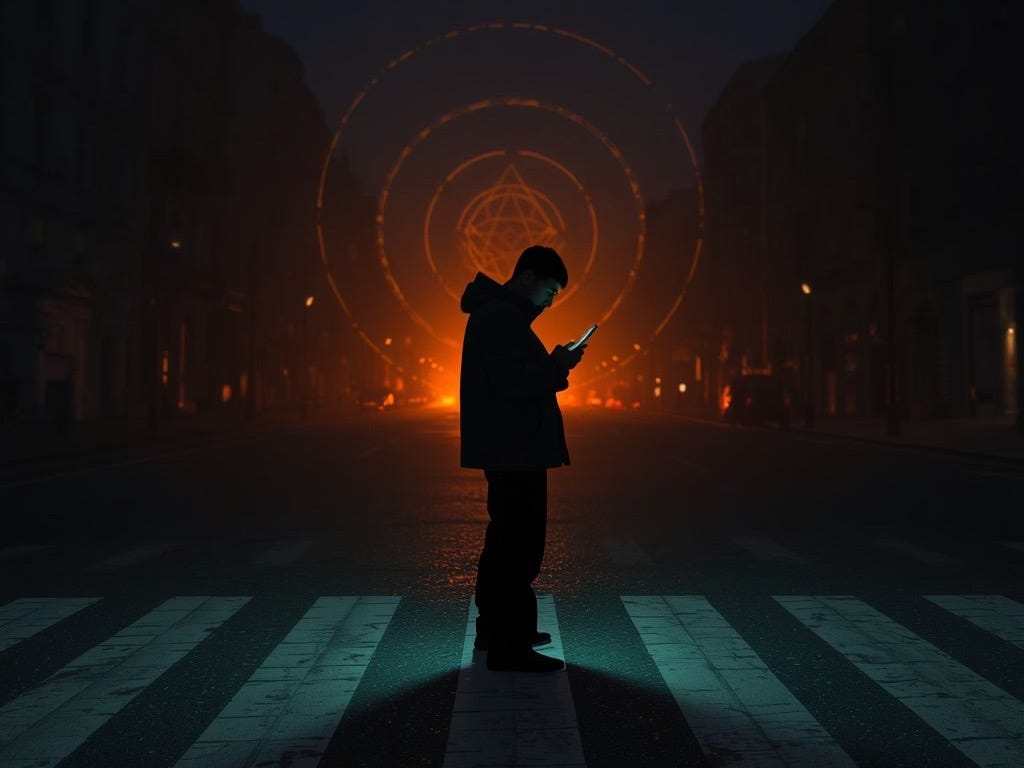
Yesterday I watched a woman walk into a crosswalk without looking up from her phone. A car had to stop hard. She didn’t flinch. She didn’t even notice. And I realized something I’d been circling for a long time: we have built a world where people will literally risk their lives to not miss a notification.
This is what “progress” looks like now.
I’m not anti-tech — I use it every day and I see the upside. But somewhere along the line, “convenience” started coming with a hidden cost: complexity, fractured attention, and the slow erosion of real human connection. A lot of people sense this but rarely say it out loud. I want to try.
01 — Simple Tasks Aren’t Simple Anymore
Logging into an account used to take a few seconds. Now it’s passwords, passkeys, verification codes, security prompts, app approvals, and two-factor authentication. Every layer was added for a reason — security matters. But the cumulative effect is exhausting. You’re jumping through hoops just to check a balance or read a message. No single moment breaks you, but the slow accumulation of tiny annoyances makes you feel like technology is working against you rather than for you.
02 — We’re Not Communicating. We’re Managing Channels
What used to be a phone call is now scattered across a dozen platforms, each with its own inbox and its own unread count silently climbing:
Text · Email (multiple accounts) · WhatsApp · Telegram · Signal · Instagram DMs · Facebook Messenger · Discord · Slack · Spotify (yes, really)
Checking one app becomes checking ten. Responding to a friend becomes a task list. The cognitive load of tracking who said what, where, on which platform — that’s a real mental burden that didn’t exist a generation ago. With more ways to reach people than ever, conversations have gotten thinner. More transactional. A lot of what passes for communication now is really just signal-checking: Are you there? Did you see that? React with a thumbs up if you got this.
03 — Your Phone Never Shuts Up. And Neither Does Your Head
And layered on top of all of it — on top of managing every inbox on every platform — there is the noise. The constant, all-day, inescapable noise.
Your phone is dinging and pinging from the moment you wake up. Emails. News alerts. App updates. Calendar reminders. Someone liked your photo. A package shipped. A package arrived. Your bank wants you to know something. An app you haven’t opened in six months has “a message for you.” And then there are the group texts — which deserve their own category of chaos entirely. Someone sends a meme. Fifteen people respond with laughing emojis, one at a time. Someone goes off-topic. A side conversation starts. Your phone buzzes eight times in forty seconds about something that has nothing to do with you, and by the time it stops you’ve completely lost whatever thought you were in the middle of. That’s not communication. That’s ambient noise with your name on it.
And here’s the part that really gets to me: we’ve become so overloaded that we now use the technology to manage the technology. You set a reminder so you don’t forget the reminder. You set three alarms for the same thing because you don’t trust yourself to catch the first one. You screenshot something and text it to yourself. You email yourself a note at 11pm so you don’t lose it by morning. You’ve become your own personal assistant — scheduling, flagging, tagging, forwarding — just to keep up with the basic information of your own daily life.
Think about that for a second. We are using apps to remind us of things that, not long ago, we simply remembered. The tool caused the problem, and then sold us another tool to manage it.
04 — More Connected. Less Connected
We’re supposedly more connected than ever — but in a real, human sense, we might actually be less connected. Yes, we can reach someone across the world instantly. That’s incredible. But the people physically next to us — across the table, in the same house — are often communicating through screens instead of face to face. I’ve seen it constantly, especially with younger generations: a room full of people, each in their own private digital world. Technically together. Actually alone.
“Being in the same room isn’t the same as actually being there. Presence got replaced by proximity.”
Real connection isn’t just information exchange. It’s eye contact, tone of voice, body language — the subtle, unspoken human stuff you can’t replicate through a screen. The more we default to screens, the more we forget what we’re missing.
05 — Stimulation Is Not the Same as Connection

This distinction explains why so many people feel hollow even when they’re constantly “on.”
Digital interaction gives you notifications, likes, and quick replies — little bursts that keep you engaged. It’s stimulating, controlled, filtered, and always available.
Human connection gives you eye contact, shared space, and real presence. It regulates you. It settles your nervous system. It’s unscripted, real, and increasingly rare.
One stimulates. The other regulates. You feel it in your body: when you’re actually sitting with someone, looking them in the eyes — something shifts. Your breathing slows. Your shoulders drop. That grounding doesn’t come from a screen, no matter how warm the message on it is. We’re getting used to the faster, filtered substitute. And over time, it starts replacing the real thing — not by choice, but because it’s always there, always ready to fill the silence.
06 — Distraction Isn’t a Side Effect. It’s the Business Model
These platforms are engineered to keep us engaged — every notification, every autoplay, every infinite scroll designed to hold our attention just a little longer. Our focus is the product being sold, and the platforms are very good at their jobs.
People walk through parking lots, head completely down, checked out from everything around them. They cross busy intersections at crosswalks — places where you genuinely need your head on a swivel, where a split second of inattention is the difference between life and death — and they are staring at a screen. Not glancing. Staring. Stepping blindly into moving traffic, trusting that drivers will notice them because they are not noticing anything themselves. We have somehow normalized treating life-and-death situations like a quiet moment to catch up on messages. That is not a minor habit. It is genuinely dangerous — and we have simply gotten used to it. That is the part that should stop us cold.
Meanwhile, conversations happen through screens instead of across tables. People document experiences in real time instead of having them. Genuine presence — real, undivided presence — has become rare enough to feel remarkable when you encounter it.
07 — A Few Things That Shouldn’t Be This Hard
Websites that ambush you. You open a page and before you’ve read a word, there’s a pop-up for your email, then your phone number, framed as a “discount” but really a data grab. You’re not browsing the internet — the internet is browsing you.
Streaming that’s more complicated than cable ever was. Cut the cord, they said. Instead, content is scattered across a dozen subscriptions, each with its own login and billing cycle. You’re not saving money — you’re stacking payments. And YouTube’s infinite scroll of mostly noise turned entertainment into decision fatigue.
Autocorrect that creates problems faster than it solves them. It changes words you didn’t want changed, misses the ones you needed fixed, and “corrects” names you’ve already corrected a hundred times. You’re not just writing — you’re proofreading against the machine.
Customer service that’s somehow gotten worse. You call with a problem and get an AI that doesn’t understand plain English, menus that don’t match your issue, and “representative” spoken into the void. A five-minute fix becomes a 40-minute drain.
Updates that move everything around for no reason. The moment you get comfortable, the interface changes. Settings migrate. Menus get renamed. You’re not just using technology — you’re constantly relearning it.
08 — What Does “Progress” Actually Mean?
If something is supposed to make life simpler but makes it more complicated — is that progress? If it’s supposed to connect us but leaves us feeling more isolated — what have we actually gained?
I’m not romanticizing the past. I don’t want to go back. But I think we’ve been sold a version of progress that’s really just replacement — trading things that worked for things that are shinier, faster, and more profitable to someone else. We swapped the phone call for the group chat. The conversation for the comment thread. The moment for the photo of the moment.
Somewhere in those trades, something real got lost.
09 — Being More Intentional

The shift for me isn’t about rejecting technology — it’s about being deliberate with it. Fewer platforms. Less ambient noise. More direct communication: actually calling, actually showing up. More time inside experiences rather than documenting them from the outside.
Because the things that genuinely ground us, regulate us, and connect us haven’t changed. They’re the same things they’ve always been.
Human presence. Real conversation. Eye contact. Touch. The antidote to all of this complexity isn’t another app. It never was.